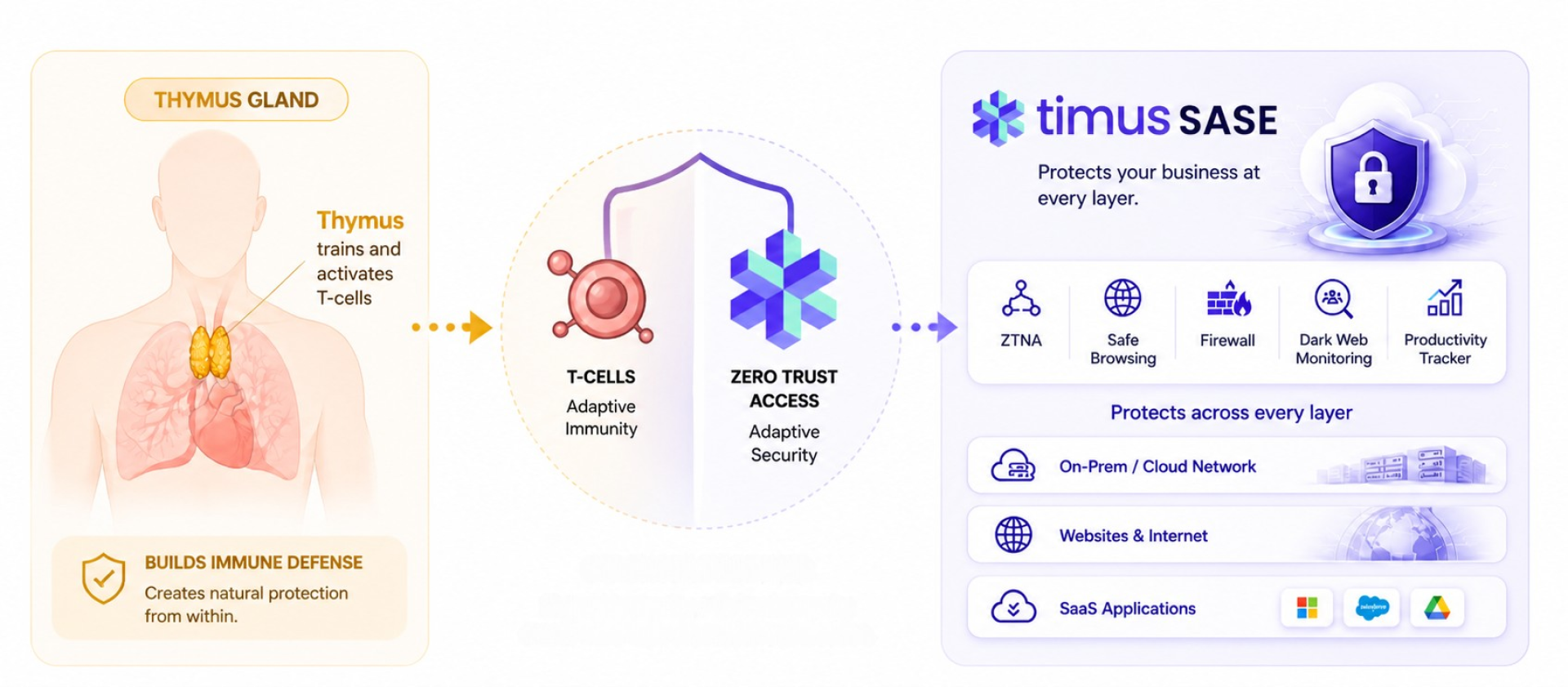



1. Introduction: The Evolution of Zero Trust
2. The Architectural Layers of Adaptive Zero Trust
Timus Adaptive ZTNA operates across multiple layers that interact continuously to verify users, devices, and sessions. Let’s break down its core components.
Sign-In Policies
At the start of a session, Sign-In Policies are applied to assess risk factors such as:
- Behavioral & Contextual Checks: User behavior and contextual factors (e.g., geo-location, IP reputation, etc.) are evaluated before granting access.
- Impossible Travel: If a user logs in from geographically disparate locations within an impossible timeframe, additional authentication measures are triggered.
- Breach Checks: Before allowing access, the system leverages integrated threat intelligence and identity risk signals of the device or user to ensure that it has not been associated with any known breaches or vulnerabilities.
Access Policies
Once a user passes the initial sign-in checks, Access Policies validate the health of the user’s device and its compliance with corporate security standards:
- Continuous Device Posture: Checks whether the device has up-to-date antivirus software, an active firewall, full disk encryption, and an approved OS version.
- Context-Aware Access Control: Adjusts access based on factors like user location and device posture.
Continuous Session Monitoring
Adaptive ZTNA doesn’t stop at any point of connection. It continuously monitors the session to ensure that no new risks arise during the user’s interaction with the network:
- Behavioral Risk Detection: The risk level is dynamically calculated using behavioral patterns and contextual session signals. This includes anomalies such as IP addresses, geolocation, and session activity.
- Posture Drift Detection: Continuous monitoring of device health and user activity ensures that if session posture changes, the system triggers predefined actions.
Responders & Risk Engine
The Risk Engine powers the automated decision-making in Adaptive ZTNA. It uses real-time data to trigger automatic actions based on predefined policies:
- Automatic Actions: If risky behavior is detected (e.g., switch to untrusted IP), the system can automatically terminate the session, enforce MFA, or tag the device.
- Dynamic Response: The system continuously adapts, modifying security measures based on the evolving risk landscape. For example, if a user’s behavior deviates from normal, the system can prompt for additional verification, block access, or ban the user.
3. Integration Ecosystem
Receive data from Endpoint Protection (EPP)
Adaptive ZTNA integrates with leading EPP solutions like Bitdefender, Heimdal, SentinelOne, and Microsoft Defender to gather continuous telemetry on device posture. This data is fed into the risk engine, where it’s used to decide whether access is allowed or denied based on the device’s health.
Send Webhook to External Systems
Send webhook to internal security tools to forward event data.
Example Scenarios:
1. Antivirus Turned Off Mid-Session
Imagine an employee starts a session on their laptop with all security controls in place (e.g., antivirus, encryption). During the session, the antivirus software is turned off. Adaptive ZTNA continuously monitors device posture and detects the change in real time. The system, as soon as the posture change is detected, connects to the device, tags the device, and sends an alert to the MSP. This automated action prevents potential threats from exploiting the device’s vulnerability.
2. Login from an Unusual Location
An employee logs in from an expected location during their usual working hours. However, the next hour, the same user logs in from an entirely different country within a short time frame, an impossible travel scenario. Adaptive ZTNA immediately triggers MFA and restricts access until the user confirms their identity. This dynamic risk assessment and response prevent unauthorized access, even before the employee can interact with the system.
Technical Differentiators: Adaptive Zero Trust vs. Legacy Models
|
Capability
|
VPN
|
Static ZTNA
|
Timus Adaptive ZTNA
|
|---|---|---|---|
|
Trust Validation
|
One-time login
|
Predefined Check-in Points
|
Continuous verification throughout the session
|
|
Response
|
Manual intervention
|
Limited (MFA, alerts)
|
Automated, real-time actions (terminate, MFA, tag device)
|
|
Device Posture Check
|
None
|
Basic (at connection)
|
Continuous, integrated EDR checks (firewall, AV, encryption)
|
|
Behavioral Context
|
None
|
Partial (IP, geo-location)
|
Real-time, adaptive behavior monitoring (geo location, IP, session drift)
|
|
MSP Readiness
|
None
|
Limited (static templates)
|
Multi-tenant, automated policy enforcement
|
|
Compliance Readiness
|
Limited logs
|
Basic reporting (manual)
|
Continuous, automated reporting
|
Key Takeaways
Adaptive ZTNA represents a significant leap forward from static access control models like traditional VPN and many ZTNA. By continuously validating users, devices, and sessions, Adaptive ZTNA eliminates the limitations of predefined trust verification, offering continuous protection throughout the entire session. This dynamic, automated approach ensures that MSPs can provide their clients with a more secure, adaptive, and scalable solution.
Key benefits include:
- Automated risk response: With continuous monitoring and real-time actions, security risks are mitigated automatically, without manual intervention.
- Send webhook: Adaptive ZTNA works natively with Timus SASE and sends event data to other critical security tools.
- Increased MSP operational efficiency: Multi-tenant support and automated policy enforcement make it easier for MSPs to manage multiple clients from a single platform.
Adaptive ZTNA represents the next stage of Zero Trust evolution, one that doesn’t wait for risk to happen, but reacts as it unfolds.
Enable the Integration if you’re a Timus partner.
Book a 30-minute Demo to see how it works for your
FAQs
What is Adaptive Zero Trust?
Adaptive Zero Trust is an evolution of traditional Zero Trust security that continuously verifies users, devices, and sessions in real time. Instead of checking trust only at predefined points, Adaptive Zero Trust evaluates risk throughout the entire session and automatically adjusts access when behavior, device posture, or context changes.
How is Adaptive Zero Trust different from traditional ZTNA?
Traditional ZTNA validates access at predefined checkpoints, usually during login or initial connection. Adaptive Zero Trust goes further by monitoring the session continuously. If risk increases mid-session due to device health changes, unusual behavior, or location shifts, access is adjusted automatically without waiting for a new login.
How is Adaptive Zero Trust different from VPNs?
VPNs grant broad network access after a single login and rely heavily on user behavior. Adaptive Zero Trust removes implicit trust by enforcing least-privilege access and continuously verifying identity, device posture, and session risk. This eliminates lateral movement and reduces the impact of stolen credentials.
Why is continuous verification important for modern security?
Threats rarely happen at login. Devices become vulnerable during sessions, users move between networks, and credentials can be compromised at any time. Continuous verification ensures that security decisions are based on real-time risk, not static assumptions made at the start of a connection.
How does Adaptive Zero Trust help MSPs?
Adaptive Zero Trust reduces manual intervention by automating access decisions and risk responses across all clients. MSPs gain centralized visibility, multi-tenant policy management, and consistent enforcement without increasing operational overhead. This leads to fewer tickets, faster response times, and stronger security outcomes.
Is Adaptive Zero Trust replacing Zero Trust?
No. Adaptive Zero Trust builds on Zero Trust principles rather than replacing them. It strengthens Zero Trust by adding continuous validation, automated response, and real-time risk awareness across the entire user session.



 Tie-mus (like “time-us,” but sharper)